

Induction Stove vs Gas: A Practical Guide to Energy Cost, Efficiency & Professional Cooking
For professional kitchens, cooking equipment is more than a tool for preparing food. It directly affects energy consumption, operating costs, kitchen temperature, workflow, and overall efficiency.
This is why the choice between gas and an induction stove deserves more consideration than simply asking which technology produces more heat.
A common assumption is that induction cooking is more expensive because it uses electricity. But when comparing the amount of energy required to deliver the same effective heat to the cookware, the numbers can tell a different story.
Based on the supplied Indonesia energy-cost comparison, gas cooking operates at approximately 45% efficiency, while induction reaches 85% efficiency. To deliver the same 2.975 kW of effective heat to the pan, the comparison requires approximately 6.61 kW of gas input versus 3.5 kW of electrical input for induction.
The result is an important consideration for professional kitchens: energy efficiency is not only about how much energy a cooking appliance consumes, but how effectively that energy becomes useful cooking heat.
Is an Induction Stove Really More Expensive Than Gas?
The answer depends on how the comparison is made.
Looking only at the electricity consumption of an induction cooker can make the technology appear expensive. However, gas cooking also loses a significant portion of its input energy before it becomes useful heat in the cookware.
In the supplied comparison, the same 2.975 kW of effective heat is used as the basis for both technologies.
| Parameter | Gas | Induction |
|---|---|---|
| Efficiency | 45% | 85% |
| Required Power | 6.61 kW | 3.5 kW |
| Effective Heat Delivered | 2.975 kW | 2.975 kW |
| Fuel / Energy Consumption | 0.59 kg LPG/hour | 3.5 kWh/hour |
| Energy Price Used | IDR 19,000/kg LPG | IDR 1,699.53/kWh electricity |
| Estimated Operating Cost | IDR 11,210/hour | IDR 5,948/hour |
| Cost Difference | — | 46.95% lower |
Under these assumptions, the induction stove has a calculated energy-cost advantage of approximately 46.95% compared with LPG.
The comparison is based on the same cooking heat being delivered to the cookware, making it more relevant to a professional kitchen than simply comparing the rated power of two different appliances.
Why Is Induction Cooking More Efficient?
The fundamental difference lies in how heat reaches the cookware.
With conventional gas cooking, energy is generated through combustion. Some of the resulting heat reaches the cookware, while some energy is transferred to the surrounding environment.
An induction stove, on the other hand, uses electromagnetic induction to generate heat directly in compatible cookware.
In simplified terms:
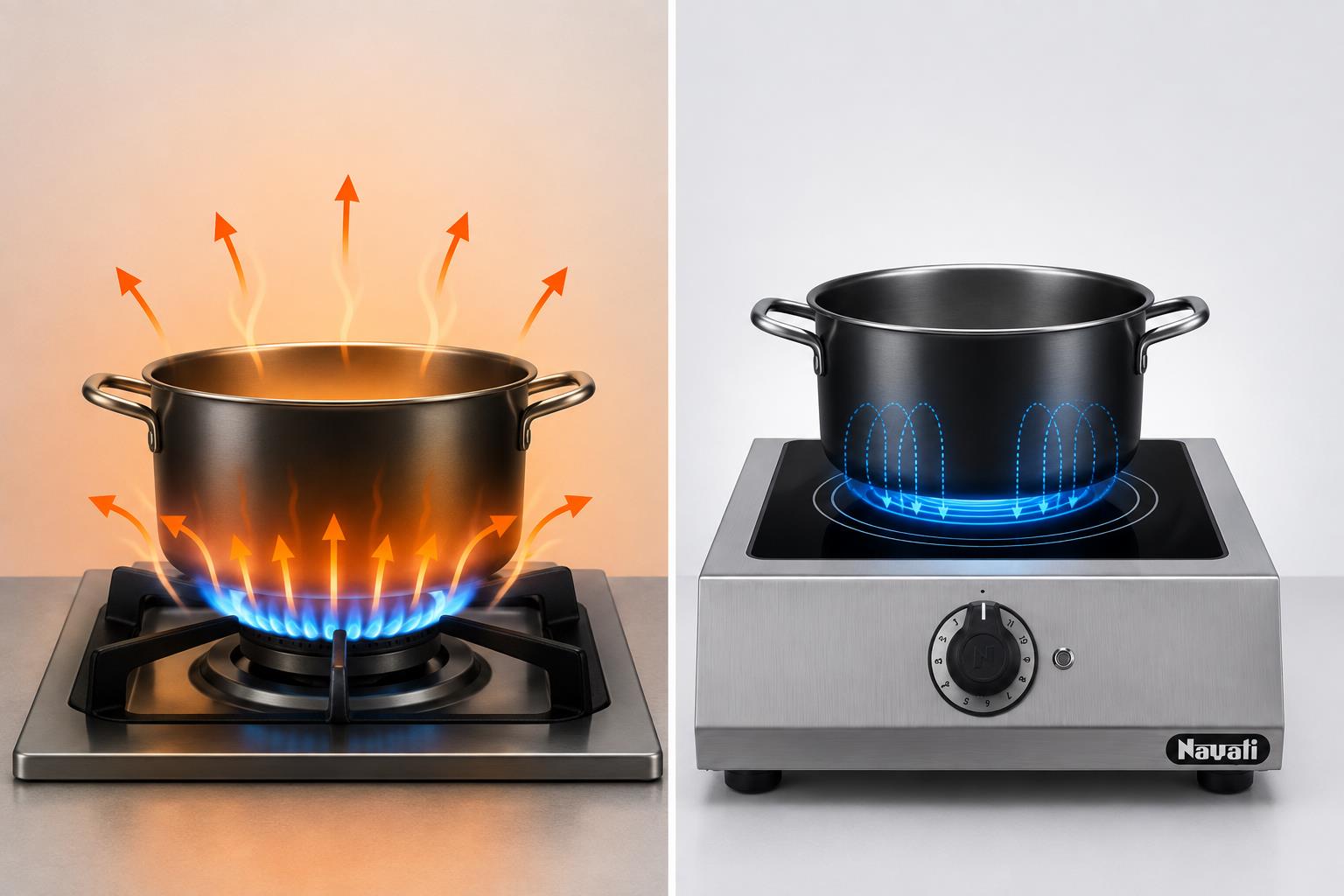
Gas
Energy → Flame → Surrounding Environment → Cookware → Food
Induction
Electrical Energy → Induction Field → Cookware → Food
This direct heating principle is one of the reasons induction cooking can achieve a higher efficiency level.
In the supplied comparison, 85% efficiency is used for induction versus 45% for gas.
For a commercial kitchen, this difference can become particularly relevant when cooking equipment operates for many hours every day.
Energy Efficiency Is Only One Part of the Decision
Choosing a commercial induction stove should not be based on energy cost alone.
Professional kitchens have different menus, cookware, cooking techniques, production volumes, and space requirements. A restaurant focused on sautéing and sauce preparation may need a different cooking configuration from a kitchen producing large volumes of wok-based dishes.
Other factors to consider include:
- Cooking application
- Type of cookware
- Daily operating hours
- Cooking volume
- Available electrical capacity
- Kitchen layout
- Cleaning requirements
- Heat management
- Operator workflow
- Long-term operating cost
This is where selecting the right induction cooker becomes important.
Induction technology can support different cooking applications, but the cooking surface and equipment configuration should match the way the kitchen actually operates.
Tabletop Induction Stove for Professional Kitchens
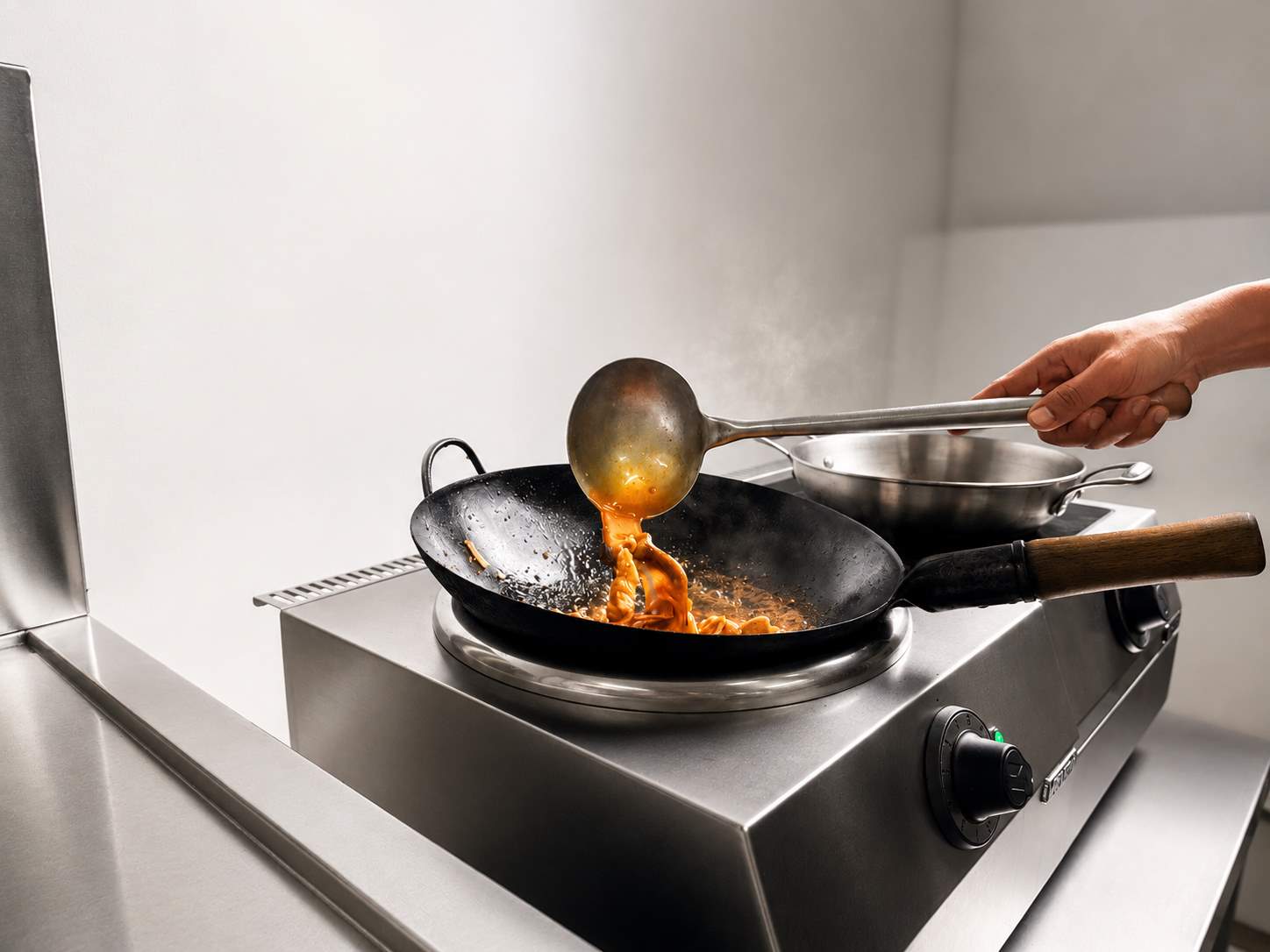
A tabletop induction stove can be a practical solution for professional kitchens that require flexibility without committing to a large built-in cooking line.
Nayati’s tabletop induction range includes solutions for both flat cooking and wok cooking applications.
NEFI-35 L: Tabletop Induction for Flat Cooking
The NEFI-35 L is positioned as a tabletop induction solution for flat cooking applications.
Its compact tabletop configuration makes this type of electric induction stove suitable for cooking applications where flat cookware is used.
Potential applications include:
- Sautéing
- Frying
- Sauce preparation
- General stovetop cooking
- Flat-pan cooking
The supplied engineering drawing shows the NEFI-35 L in a tabletop format with an approximately 400 × 500 mm footprint and 140 mm height.
For kitchens that require a compact cooking station, this format can offer a more flexible approach to incorporating induction cooking into the operation.
When Your Kitchen Calls for a Wok
Flat cookware is not the only professional cooking application for induction.
For restaurants serving Asian cuisine or menus that rely heavily on stir-frying, the cooking vessel itself becomes an important consideration.
A wok requires a different cooking approach from a flat pan. This is why a dedicated induction wok cooker can be more appropriate for wok-based professional cooking.
NEWI-35 LC: Tabletop Wok Induction
The NEWI-35 LC is designed in a tabletop configuration specifically oriented toward wok cooking.
Potential applications include:
- Stir-frying
- Wok-based cooking
- Asian cuisine
- High-temperature cooking applications
- À la minute wok stations
The supplied engineering drawing shows the NEWI-35 LC with an approximately 400 × 500 mm footprint and 240 mm overall height, giving it a different physical configuration from the NEFI-35 L.
The key principle is simple:
The right induction solution starts with the way your kitchen cooks.
Flat Induction Stove or Wok Induction Cooker?
The choice between a flat commercial induction stove and an induction wok solution should begin with the menu.
| Cooking Application | Flat Induction | Wok Induction |
|---|---|---|
| Flat-pan cooking | ✓ | — |
| Sautéing | ✓ | — |
| Sauce preparation | ✓ | — |
| General stovetop cooking | ✓ | — |
| Stir-frying | — | ✓ |
| Wok-based menus | — | ✓ |
| Asian cooking applications | — | ✓ |
If your kitchen primarily uses flat cookware, a tabletop flat induction solution such as the NEFI-35 L may be the more appropriate configuration.
If wok cooking is central to your menu, the NEWI-35 LC provides a wok-oriented induction format.
This distinction is important because choosing an induction stove is not simply about choosing between electricity and gas. It is about selecting a cooking technology and configuration that matches your operation.
What Does 46.95% Lower Energy Cost Mean for a Professional Kitchen?
The hourly difference is where the business case becomes more tangible.
Based on the supplied Indonesia comparison:
Gas: IDR 11,210/hour
Induction: IDR 5,948/hour
Difference: approximately IDR 5,262/hour
Potential energy-cost saving: 46.95%
For a kitchen operating multiple cooking stations for several hours every day, even an hourly difference can become meaningful over time.
For example, a business can use the following basic framework to estimate its potential energy-cost difference:
Hourly difference × operating hours × operating days
The actual result will depend on the kitchen’s cooking load, operating schedule, energy tariffs, LPG pricing, and equipment usage. Therefore, the figures above should be treated as a reference calculation rather than a guaranteed saving for every kitchen.
Is an Induction Stove Right for Your Kitchen?
An induction cooking solution may be worth considering if your professional kitchen is looking to:
- Improve energy efficiency
- Reduce energy operating costs
- Introduce electric cooking into the kitchen
- Optimize tabletop cooking stations
- Match cooking equipment to specific applications
- Reduce unnecessary heat around the cooking area
- Explore alternatives to conventional gas cooking
However, the right solution depends on your cooking operation.
A kitchen focused on flat cookware may benefit from a tabletop flat induction stove, while a wok-focused operation may require a dedicated induction wok cooker.
The goal is not simply to replace gas with electricity.
The goal is to use the right cooking technology for the right application.
Explore Nayati Induction
Nayati Induction provides tabletop solutions for different professional cooking applications.
NEFI-35 L
Tabletop Flat Induction
Designed for flat-pan and general stovetop cooking applications.
NEWI-35 LC
Tabletop Wok Induction
Designed for professional wok-based cooking applications.
Together, they provide two different approaches to integrating induction cooking into professional kitchen operations.
Ready to Explore Induction for Your Kitchen?
Energy efficiency is only the beginning.
The right induction stove should match your cooking application, cookware, kitchen workflow, and operational requirements.
If you’re considering switching from gas to induction—or planning a new professional kitchen—Nayati can help you identify the right solution for your operation.
Interested in Nayati Induction?
Tell us about your kitchen and discover the right induction solution for your cooking application.
Ask for Pricing via WhatsApp or Instagram DM.